
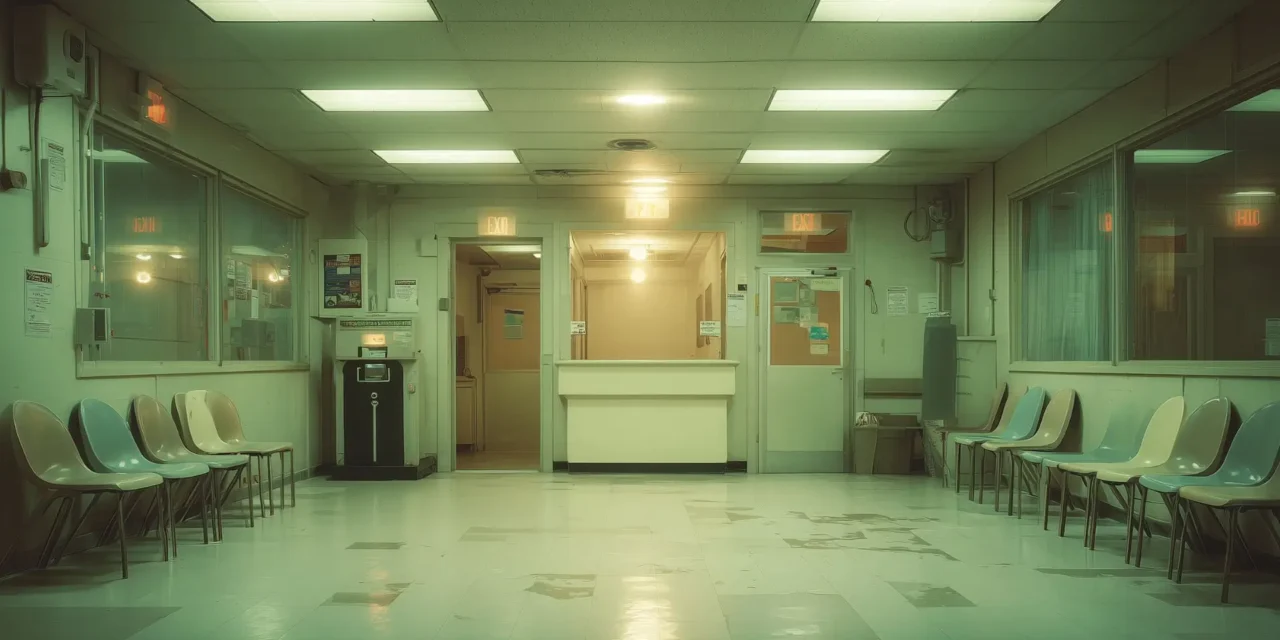
The drive to Metrowest took me through parts of Miami that felt abandoned by life. The further west I went, the more the city thinned out, giving way to acres of withered trees that stood like skeletons. Their branches were stripped and blackened, reaching upward as though trying to claw their way out of whatever desolation they’d been left in. The road itself seemed tired, cracked, littered with potholes that forced me to slow down and feel every mile of the journey.
It didn’t look like a place where anyone lived.
It looked like a place where people were put.
A wasteland before the wasteland.
A fitting path to a detention center where men waited for judgment.
By the time I pulled into the parking lot, a pressure had settled in my chest—something heavier than fear, something quieter than anger. A pastor’s dread, maybe. A father’s dread. A man’s dread of seeing someone he once trusted, someone he once discipled, someone he once called friend… behind glass.
Inside, the routine moved like a machine: metal detector, empty pockets, locker keys, the flat voice of an officer reciting policies. Everything sterile. Everything designed to strip you of comfort and assume you might be a threat.
When they called my name, I walked the narrow hallway toward a long wall of glass cubicles. Visitors on one side, inmates on the other. A row of telephones hanging between us like lifelines no one wanted to grab.
I sat down at my assigned seat and waited.
When David appeared on the other side of the glass, my first thought was that he looked like a man whose body had forgotten how to house a soul. He was thinner than I’d ever seen him—his cheeks hollow, beard patchy, eyes sunken and darting with the anxious awareness of someone who’d been trying to stay small in a cage full of larger predators.
He lifted the phone, and after a moment, I lifted mine.
For a second, neither of us spoke.
There was a world of difference between the man I remembered and the man in front of me now. I had known him in community—laughing, serving, sharing meals, praying. I had seen him with his family, watched his kids run around while he made jokes, listened to him talk about wanting to grow in Christ. I had counseled him through struggles. I had believed him.
And now I was looking at a stranger wearing his face.
When he finally spoke, his voice cracked—thin, trembling, soaked in humiliation.
He talked about his guilt in broad terms.
He talked about sin.
He talked about God.
He talked about repentance.
But he didn’t talk about the victim.
He didn’t talk about the details.
He didn’t name the wound.
And part of me wondered whether he was protecting himself or trying to convince himself.
As he spoke, a verse surfaced in my mind uninvited:
“The sacrifices of God are a broken spirit; a broken and contrite heart, O God, you will not despise.”
His spirit looked broken.
But mine despised him anyway.
It wasn’t hatred.
It wasn’t rage.
It was something deeper and quieter—an ache with teeth.
I listened to him speak about repentance, about finally understanding the weight of sin, about wanting forgiveness, about wanting God. Everything he said was correct, doctrinally sound, shaped like remorse.
But was it conviction?
Or survival?
Was it God’s work?
Or fear of inmates who beat men like him?
Were his tears the kind that cleanse… or the kind that stain?
I couldn’t tell.
And that uncertainty was its own kind of wound.
What I did know was this: judging his heart was impossible. Judging his words was necessary. Judging my own heart was unavoidable. Because while he spoke, all I could think about was his victim—the little girl whose innocence he had eroded a piece at a time. And I didn’t know then that my own child’s story would mirror hers. I didn’t know yet how close the pain would hit.
But even without that knowledge, the thought of her sat between us like a third presence.
Sitting there behind the glass, I felt the fracture inside myself widening. The pastor in me wanted restoration. The man in me wanted distance. The father in me wanted justice. The disciple in me wanted obedience. The friend in me wanted answers. The human in me wanted to look away.
But I stayed.
I listened.
That’s what love required, even when it didn’t feel like love.
That’s what obedience required, even when it didn’t feel like obedience.
That’s what following Jesus required, even when every part of me wished the burden belonged to someone else.
When the visit ended, he pressed his palm against the glass for a moment—a small, desperate gesture from a man undone. I didn’t lift mine to meet it. I couldn’t. Not then.
I walked out of Metrowest carrying a weight I didn’t have language for yet. I couldn’t shake the look in his eyes, the collapse of the man I thought I knew, or the hollow echo of sin when it finally stops pretending.
Outside, the sky was the same dim gray as when I had arrived.
Nothing had changed.
And yet everything had.
I didn’t know it then, but this was only the first layer.
Only the first fracture.
Only the first step into a storm I could not imagine.
The glass between us was temporary.
What it represented was not.
Faith in the Dark is Jesse Velez’s true story of enduring faith, costly obedience, and discovering God’s presence in seasons of grief and silence. Best to read the 12-Part Series in order:
- The Night the Police Lights Found Me
- The Call That Split My World
- Behind the Glass
- Life as a Pastor, Father, and Protector
- My Daughter’s Disappearing Act
- My Mother’s Drive and the Truth She Carried
- Holding My Family’s Pain in My Hands
- Loving the Guilty and the Wounded at the Same Time
- The Jesus I Wanted vs. the Jesus I Needed
- Forgiveness With the Lights On
- Faith Inside the Fire
- The Road That Goes On







Recent Comments