

Long before I understood what she had walked through, I knew my daughter had a sensitivity to God that wasn’t common in children. She came to faith early—not by pressure, not by imitation, but by something real happening in her heart. She prayed with a kind of sincerity adults spend years trying to rediscover. She listened when Scripture was read. She paid attention in ways that didn’t match her age.
I used to think she was simply emotionally aware, or spiritually curious, or blessed with a tender heart. It wasn’t until we learned the truth that I understood: her early faith was not preparation for trauma. It was preservation through it.
When she was nine—the age innocence should be protected, not violated—she prayed. She talked to God. She held conversations with Him that children shouldn’t need to have. In the darkness of what she endured, she clung to a light she did not fully understand but somehow trusted.
I believe now that the Holy Spirit was keeping her alive from the inside out. Not physically—though He sustained her—but emotionally, spiritually, mentally. The kind of survival she walked in was not natural. It was a quiet miracle.
After the revelation came out and the dust of shock settled into the air of our home, I found myself remembering moments from her childhood that suddenly meant something different. Moments when she sat alone with her Bible. Moments when she asked questions far too deep for her age. Moments when she seemed wise in a way no child should have to be.
At the time, I chalked it up to personality.
Now I see it was faith trying to find oxygen in a suffocating world.
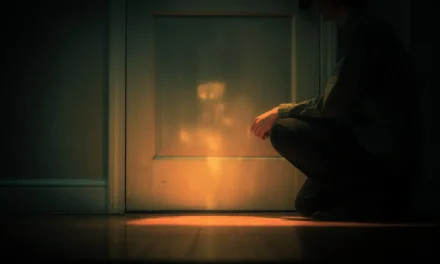
One day—not long after the truth surfaced—I sat with her in the living room. She was smaller then, not physically, but emotionally. Trauma has a way of shrinking people before it strengthens them. She stared at nothing in particular, wrapped in a blanket, shoulders drawn inward like someone trying to hold herself together.
We talked softly, as you do with someone whose soul is bruised.
I told her we loved her.
That none of this was her fault.
That we would walk with her through all of it.
She nodded, barely speaking, her eyes glossy but not spilling over. And then, almost as an afterthought, she said something that stilled me:
“God was with me.”
Not bitter.
Not questioning.
Not angry.
Just certain.
The words stunned me—not because they weren’t true, but because they revealed a faith forged in places I never wanted her to be. A faith that didn’t collapse under trauma, but held onto the only hand strong enough to keep her afloat.
I didn’t know what to say. I didn’t know how to reconcile the God who allowed her suffering with the God she believed had been with her in it. That tension lived in me, not in her. She didn’t need to debate theology. She didn’t need explanations. She wasn’t asking why.
She simply knew she had not been alone.
Her survival wasn’t a testimony to her strength.
It was a testimony to the God who dwells near the brokenhearted, who enters the fire with His children instead of pulling them out on demand.
I later realized that her faith—small, innocent, trembling—wasn’t a flicker trying to survive the wind. It was a torch held tight in a storm. It shouldn’t have lasted. It shouldn’t have stayed lit. But it did.
And the truth is:
the flame was not hers.
It was God’s.
Her story didn’t strengthen my theology—it broke it open. It forced me to look at suffering without easy answers. It forced me to admit that God’s presence doesn’t always look like protection from pain. Sometimes it looks like endurance inside it.
It forced me to see that healing is not proof that the fire never happened.
It is proof that God was in the flames with her.
As months passed, I watched her slowly find her footing again. Not quickly. Not cleanly. Trauma is not generous with timelines. But she prayed. She worshiped. She journaled. She reached for God with the same quiet determination she had as a child—only now with the weight of survival in her hands.
Her faith didn’t disappear in the fire.
It grew roots.
Deep roots.
Roots I didn’t know she had.
Roots I wish she had never needed.
But they were there, and they were real.
As her father, I still grieve what she endured. There are days when sorrow passes through me like a shadow. But there are also days when I look at her and see faith that has been tested and found genuine. Not because she is unscarred, but because she is still standing.
And I know this:
God carried her when we didn’t know she needed carrying.
God saw her when we didn’t see.
God comforted her when we didn’t know she was hurting.
God preserved her when we couldn’t protect her.
She walked through a fire no child should know.
But she did not walk alone.
Faith in the Dark is Jesse Velez’s true story of enduring faith, costly obedience, and discovering God’s presence in seasons of grief and silence. Best to read the 12-Part Series in order:
- The Night the Police Lights Found Me
- The Call That Split My World
- Behind the Glass
- Life as a Pastor, Father, and Protector
- My Daughter’s Disappearing Act
- My Mother’s Drive and the Truth She Carried
- Holding My Family’s Pain in My Hands
- Loving the Guilty and the Wounded at the Same Time
- The Jesus I Wanted vs. the Jesus I Needed
- Forgiveness With the Lights On
- Faith Inside the Fire
- The Road That Goes On








Recent Comments