
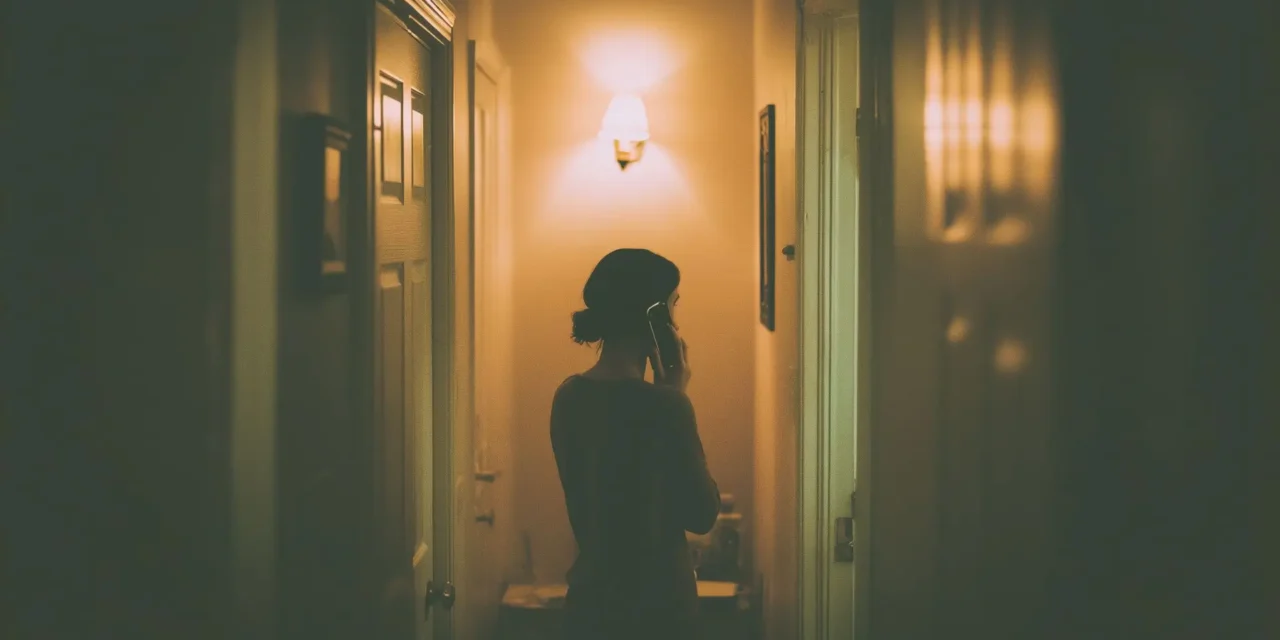
It was early—too early for anyone to be calling unless something was wrong. I was still half-asleep when I heard my wife’s phone ringing somewhere in the room. She was already awake and slipped out into the hallway, the way people do when they want privacy but don’t want to say so. The house was quiet except for the soft murmur of her voice through the cracked bedroom door.
I lay there blinking at the ceiling, uneasy without knowing why. There’s a certain kind of silence that follows a phone call in the early hours of the morning—the kind that carries its own warning. I could hear her voice drift in and out of the hallway, but not enough to understand anything. Just enough to know that whatever she was hearing wasn’t good.
When she came back toward the bedroom, I whispered the question without sound, mouthing the single word: Who?
She tried to ignore me, but I asked again, quietly, insistently. Finally she told me and I sat up instantly.
All she had to say was the name—David—and the room shifted. Everything in me woke up at once, as if someone had thrown ice water on my senses. She stepped back into the hallway to finish the call, leaving me sitting upright in the dark.
The phone conversation ended, and she returned with the summary that would split my world open.
David had been arrested that morning.
The accusation: he had been molesting his stepdaughter for years—starting when she was nine, escalating as she approached fourteen, until finally the girl had called the police because she was afraid he would move on to her little sister next.
I remember staring at my wife, not fully understanding the words at first. They felt too heavy to process all at once. I repeated them silently, as if they might rearrange themselves into something less horrible.
But they didn’t.
They stayed exactly as they were—cold, blunt, devastating.
I knew the family.
I knew the girl.
I knew the mother.
I knew the home they lived in, the dinners we shared, the small-group nights where laughter mixed with confession, the simple moments of community and discipleship.
And I knew David.
Or at least, I believed I did.
For a few seconds I felt suspended between disbelief and recognition. Memories rose up uninvited—moments that once meant nothing now flickered with unfamiliar meaning. A gesture, a tone, small behaviors that once seemed like personality quirks suddenly cast longer shadows. Red flags I had noticed but explained away. Discomfort I dismissed as poor parenting or awkward family dynamics.
None of those memories had ever formed a complete picture.
But now, in the dim light of that early morning, the pieces rearranged themselves into something I wished I’d never seen.
I wasn’t angry yet.
I wasn’t even fully conscious of the betrayal.
The first emotion I felt was something far more pastoral and far more painful:
Responsibility.
Not for his actions—no one could carry that weight except him—but for the aftermath. For the people waking up that morning with their lives detonated. For a girl who had held a secret far too long. For a mother frozen in shock. For a small group that would soon learn their brother had been living a double life. For a church family that trusted me to shepherd them.
I didn’t think about guilt or innocence.
The allegation alone was enough to turn a household into a war zone.
I reached out to the couples in our small group.
I told them what little we knew.
We didn’t have solutions—only comfort to offer, and even that felt insufficient. Words can feel like cotton when someone is bleeding.
As the morning unfolded, more layers of reality pressed down. I thought about the training I’d received over the years—how churches are warned to watch for predators, how leaders are taught to create spaces that protect children, how I had been trained to notice subtle behaviors. And yet, nothing in my training prepared me for this moment.
I thought about the stories I’d heard in my life—the friend who was abused by his sister and didn’t remember it until adulthood, the statistic that once said one in four girls in America suffer abuse, the fact that my own family wasn’t untouched by predators in previous generations. I thought I understood the world. I thought I understood sin.
But this was different.
This was near.
Too near.
In that moment, the house felt smaller. The future felt thinner. The weight sitting on my chest felt strangely familiar, as if I had known all along that something was coming but didn’t know what shape it would take.
I moved through the day quietly, almost mechanically. I offered prayer, counsel, presence—whatever fragments of myself I could gather. But beneath all that activity, something inside me had started to unravel. The man I believed I knew was gone. In his place was someone I did not recognize, someone dangerous in ways I had never imagined.
And though I didn’t know it yet, this phone call was not the full quake.
It was the tremor before the earthquake.
The day the ground began to split beneath me.
Faith in the Dark is Jesse Velez’s true story of enduring faith, costly obedience, and discovering God’s presence in seasons of grief and silence. Best to read the 12-Part Series in order:
- The Night the Police Lights Found Me
- The Call That Split My World
- Behind the Glass
- Life as a Pastor, Father, and Protector
- My Daughter’s Disappearing Act
- My Mother’s Drive and the Truth She Carried
- Holding My Family’s Pain in My Hands
- Loving the Guilty and the Wounded at the Same Time
- The Jesus I Wanted vs. the Jesus I Needed
- Forgiveness With the Lights On
- Faith Inside the Fire
- The Road That Goes On






Recent Comments