
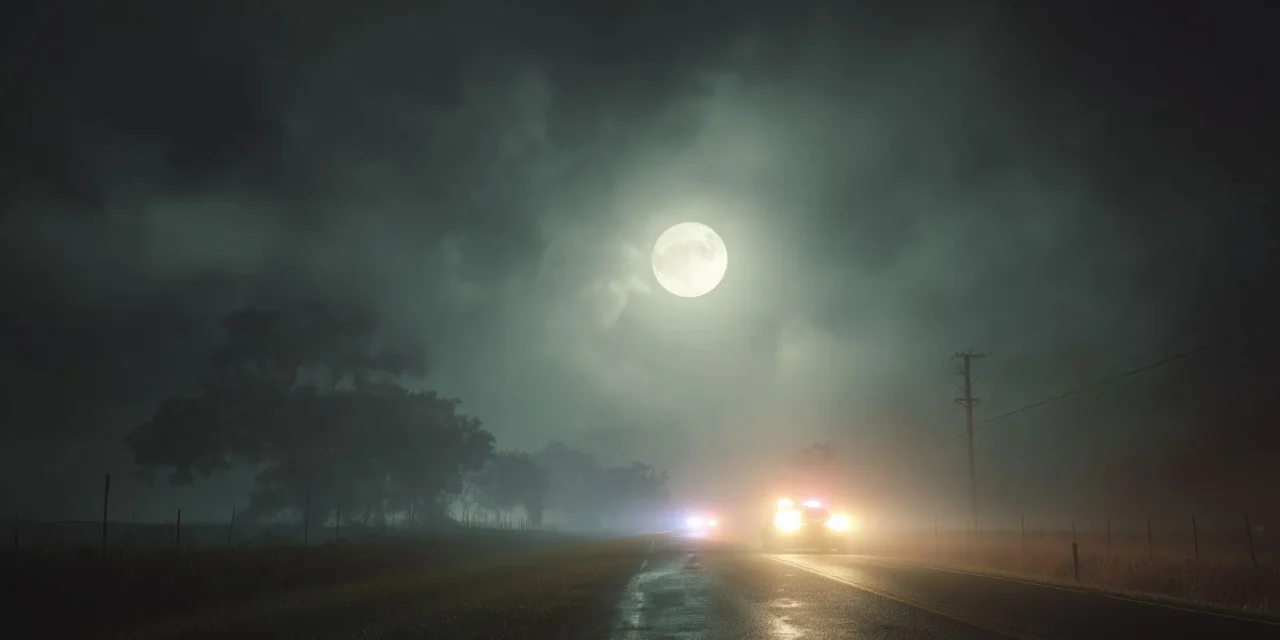
The flashing blue and red lights hit the windows before I even heard the sirens. They pulsed through the fogged-up glass of the minivan like strobes in a slow, relentless rhythm, painting everything inside with a kind of dreamlike distortion. It was the first moment in my life I understood the word surreal not as vocabulary, but as experience.
It was just after two in the morning, deep in the Redlands—far from the streetlights and noise of Miami, and even farther from the concrete canyons where I grew up in New York City. This place was quiet in a way that made sound itself feel out of place. Fields on either side. A dead-end road. A moon that hung low and cold.
And me—forty-seven years old, brown-skinned, sitting in an illegally parked minivan beside a man who had just been released from prison hours earlier.
David.
White socks. Flip-flops. A gray hoodie hanging off his thin frame like a loose thread on a life unraveling.
A convicted child molester.
My friend.
My brother in Christ.
My new enemy.
I saw the police car in the mirror first, then another behind it. Their high beams cut through the darkness, and for a second I thought about what they must be thinking. A Hispanic man in a dark van with a white male ex-convict on a deserted road at 2 AM. Nothing about the scene suggested innocence or wisdom or pastoral duty.
And still, somehow, what I feared wasn’t what they would think of me. I feared for him.
Before the officer reached the window, I shifted from imagination to truth. I pulled out my driver’s license, nodded to David to lower his window, and prepared to answer every question before it could be asked. Years of working with the formerly incarcerated taught me that hesitation can be misinterpreted, and misinterpretation can become danger fast.
When the officer bent down to peer inside, he filled the window frame—broad shoulders, stern expression, flashlight aimed straight at us. My license was already in my hand, extended toward him before he said a word.
“My name is Jesse Velez,” I said. “I’m David’s pastor. He was just released tonight. His ankle monitor requires him to be at this location.”
I unloaded everything—who, what, where, why, when—like I was defusing a bomb with my voice. The officer’s eyes switched between the two of us, calculating. David sat silent, small, staring ahead as though waiting for judgment.
I didn’t feel unsafe.
I didn’t worry about my life.
Not in that moment.
But David? If this encounter went wrong—if the officer misunderstood, if protocol turned aggressive, if suspicion outpaced explanation—it wouldn’t be my body paying the price. It would be his.
And that realization was its own kind of torment.
Because even then, after what he had done—after the betrayal, after the wound his actions carved into the life of the girl he harmed, and the wound still bleeding inside my own family—my instinct wasn’t to abandon him. It was to protect him.
Obedience is a strange teacher.
I watched the officer examine David, then me, then the van, then the quiet dark field around us. The Redlands is not a place where people casually sit in parked cars in the middle of the night. Nothing about this scene suggested the right thing was happening. Everything about it suggested the wrong thing was.
But the officer didn’t escalate. He didn’t shout or demand I step out. He simply asked a few questions, listened, and then stepped back into the night to confer with the others.
When he returned, he told us we could stay—but only if we moved the van further onto the grass and didn’t return to this spot again. His tone was calm but clear. We were an inconvenience, a risk, and a mystery all at once.
After he walked away, the silence settled again. Heavy. Damp. Almost alive.
David exhaled shakily.
And I sat there, hands on the wheel, wondering how a pastor, a father, and a wounded man had ended up in the middle of nowhere, watching police lights fade into the darkness while sitting beside someone who had broken the heart of a child the way my own child’s heart had been broken.
I didn’t have the full answer that night.
Only later would I understand that this moment—this cold, lonely, moonlit road—was the doorway into a deeper kind of obedience. A kind that wasn’t clean or noble or easy. A kind that tore open every quiet place inside me. A kind that forced me to look at the face of someone who committed the unthinkable and ask what it meant to follow Jesus here, of all places.
But that night, all I knew was this:
I wasn’t in the Redlands because I wanted to be. I was there because love—God’s stubborn, unyielding, inconvenient love—had driven me straight into the darkness. And the police lights had simply found me where obedience had already taken me.
Faith in the Dark is Jesse Velez’s true story of enduring faith, costly obedience, and discovering God’s presence in seasons of grief and silence. Best to read the 12-Part Series in order:
- The Night the Police Lights Found Me
- The Call That Split My World
- Behind the Glass
- Life as a Pastor, Father, and Protector
- My Daughter’s Disappearing Act
- My Mother’s Drive and the Truth She Carried
- Holding My Family’s Pain in My Hands
- Loving the Guilty and the Wounded at the Same Time
- The Jesus I Wanted vs. the Jesus I Needed
- Forgiveness With the Lights On
- Faith Inside the Fire
- The Road That Goes On






Recent Comments