
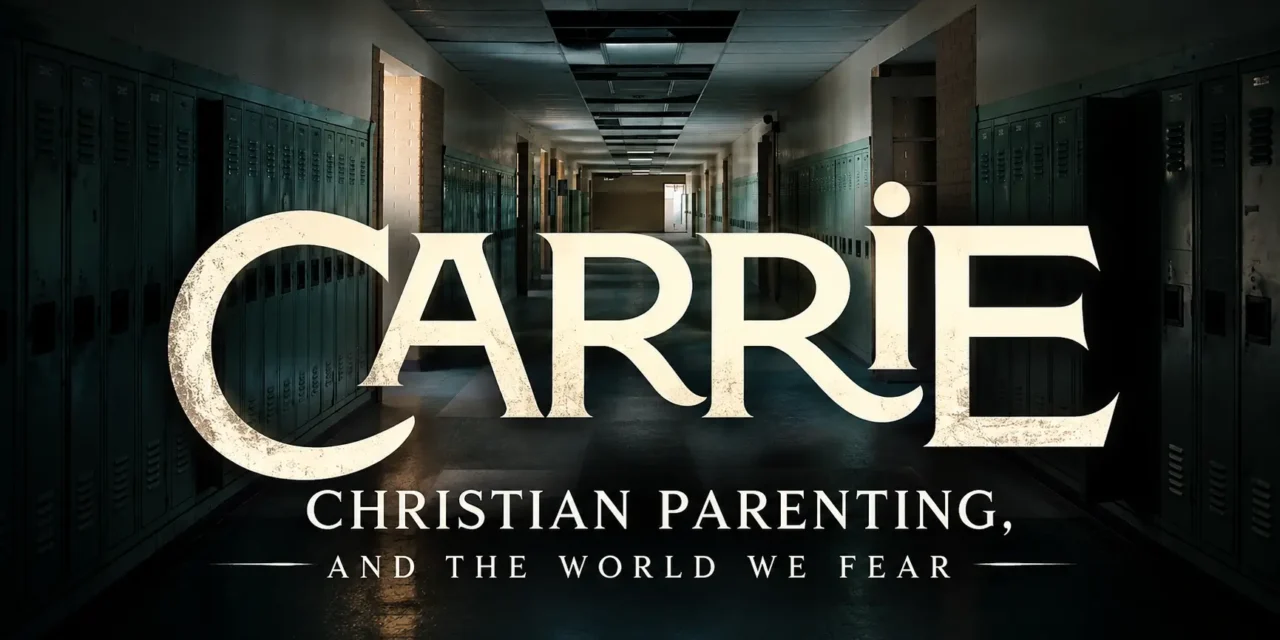
I never expected to watch a horror series and find myself identifying with the mother everyone was supposed to be afraid of. But that’s exactly what happened.
I recently watched Carrie, the limited series on Prime Video developed by Mike Flanagan and based on Stephen King’s novel. I’m not going to review the entire series. There are plenty of reviews discussing the horror, performances, and how this adaptation compares to earlier versions. What caught my attention was much more personal: Carrie’s mother, Margaret.
Now, before anyone starts worrying about my children, let me explain.
I didn’t identify with Margaret’s controlling behavior or the way she isolated Carrie. But I recognized something in the way she spoke about the world outside her home. She had genuine concerns about how people lived and what they believed. She was convinced that her family’s values were different from those of the world around her, and she wanted to protect her daughter from its influence.
That resonated with me because, as a Christian father of five, I raised my family with similar convictions. We believed we were called to live differently. We were in the world, but not of the world. That wasn’t just something we repeated in church. It shaped how we approached education and the values we wanted to establish in our home.
Like Margaret, I sometimes looked at the world outside our doors and wondered what it would do to my children. But as the series continued, I began noticing something about her that made me uncomfortable. We shared some of the same concerns, but our responses to those concerns were very different.
A Note About the Series: Carrie contains disturbing material, including sexual situations, suicide, strong language throughout, graphic violence, and bullying. While I found the series thought-provoking, this article shouldn’t be understood as a general recommendation to watch it. If you already watch mature horror or psychological thrillers, you may find it worth considering. Otherwise, be aware that its content can be intense and unsettling. Spoiler Alert: This article also discusses specific scenes and character developments.
A Mother Under Pressure
One thing I appreciated about this adaptation is that Margaret isn’t introduced simply as an unreasonable religious mother who wants to keep her daughter locked away from society. We’re shown a woman dealing with the tragic death of her husband, struggling to hold together what remains of her family.
Then children’s services becomes involved. Suddenly, the life Margaret has constructed for herself and Carrie is being challenged by people who believe they know what’s best for her daughter. Carrie must attend school, and Margaret must find employment. If she doesn’t cooperate with the changes being required, she faces the possibility of losing custody of her child.
Think about that for a moment. She’s grieving her husband, struggling with her own fears, and now facing the possibility that the government could take away her daughter. I don’t agree with how Margaret raised Carrie, but I can understand why she feels threatened.
Parenting is difficult enough when life is going reasonably well. Add grief and financial pressure, along with people questioning your ability to raise your child, and things can become overwhelming.
This is where I began feeling some empathy for Margaret. Her methods were troubling, but some of her concerns were recognizable. It’s easy to dismiss a parent whose decisions we disagree with. It’s harder to consider what fears or experiences may be driving those decisions.
Of course, understanding someone’s fears doesn’t mean we have to approve of what they do because of them.
When the World Proves You Right
There’s a scene that particularly caught my attention. Carrie returns home after her first day of school, having experienced a school shooter drill. For a girl who has spent much of her life sheltered from the outside world, that’s a frightening introduction to public education.
Carrie asks her mother why she hadn’t told her about the dangers that existed outside their home. Margaret responds by talking about how ugly the world has become. She complains about society taking away Bibles, prayers, and guns. Then she essentially tells Carrie that she had warned her about the world, and now Carrie has seen it for herself.
I recognized that response because I’ve had similar concerns about the direction of our culture. I’ve questioned decisions made by educational institutions and worried about the things my children might encounter that contradicted what we were teaching them at home. And yes, I’ve probably had my own I told you so moments.
But something about Margaret’s response bothered me. She seemed more interested in being proven right about the world than comforting her daughter after a frightening experience.
There was a sense of vindication in her words. The world was exactly as terrible as she had warned Carrie it would be, and now her daughter had seen the evidence for herself.
I think parents need to be careful here, myself included. We can become so convinced that we’re right about what’s wrong with the world that we begin treating our children’s experiences as proof of our arguments. But our children aren’t supposed to become exhibits in our case against society.
Carrie needed reassurance and help understanding what she had experienced. Instead, Margaret seemed to use the moment to reinforce the idea that the outside world was something to fear.
Watching that exchange reminded me of how my wife and I tried to approach difficult realities with our own children.
The Bible Is Practically TV-MA
When our children were growing up, my wife and I tried to keep things age-appropriate. We weren’t interested in exposing them to everything the world had to offer simply because it existed. Some things weren’t appropriate for their age, and some things weren’t appropriate at all.
But we also understood that we couldn’t protect them from every uncomfortable reality.
Frankly, if you’ve read the Bible from Genesis to Revelation, you know it’s hardly a collection of bedtime stories suitable for every age. There’s murder, adultery, sexual violence, betrayal, and war. The Bible is practically TV-MA. Some of those Old Testament stories would make a streaming service’s content advisory department work overtime.
Yet Scripture doesn’t hide the realities of human sin. It tells us what people are capable of, including some people God used in remarkable ways. The Bible also shows us the consequences of sin and the mercy of God toward people who desperately need it.
That’s what we wanted our children to understand. We weren’t trying to convince them that evil didn’t exist. We wanted them to recognize it and learn to respond to life through the truth of God’s Word.
Of course, that required discernment. There are things a five-year-old doesn’t need to know that a fifteen-year-old should be prepared to discuss. And there are conversations parents should have with their children before someone else has them.
Jesus addressed the reality of living in a fallen world in John 17. While praying for His disciples, He asked the Father not to take them out of the world, but to keep them from the evil one (John 17:15). A few verses later, He spoke of sending them into the world.
Jesus wasn’t teaching isolation. His followers would remain among people who didn’t share their faith, and they would face opposition. Yet He prayed for their protection.
I believe that gives Christian parents something important to consider. We have a responsibility to protect our children, but we also have to prepare them for a world that won’t always agree with what we’ve taught them.
And for many families, one of the first places that tension becomes real is school.
Who Decides What’s Best for the Child?
Another part of Carrie that resonated with me was the conflict between Margaret and the institutions now involved in her daughter’s life.
Children’s services, school administrators, teachers, and guidance counselors all become part of the discussion about what’s best for Carrie. And there’s a phrase that kept coming to mind as I watched: the best interest of the child.
It’s a phrase that sounds wonderful. Who wouldn’t want what’s best for a child? But two people can genuinely want what’s best for a child and disagree completely about what “best” means.
Margaret believes she’s protecting Carrie from a corrupt world. The school believes Carrie needs an education and opportunities to develop beyond the confines of her home. Both believe they’re acting in her best interest, but they’re operating from different convictions about how children should be raised.
I experienced that tension myself.
I wanted my children to learn mathematics, science, history, and literature. I generally trusted educators to do their academic jobs. But I was much more cautious when educational institutions began involving themselves in my children’s moral and spiritual development, or when their approach to social and emotional issues conflicted with what we believed.
It wasn’t that I considered those areas unimportant. Quite the opposite. I believed they were too important to leave entirely to people whose convictions might differ significantly from ours.
Sometimes I felt that institutions had what Carrie describes as “an agenda.” By that, I mean a particular understanding of what children should learn and how they should view the world. Parents have those convictions too, whether they recognize them as a worldview or not.
The challenge comes when those convictions collide.
What interested me about Carrie is that the series doesn’t simply present one side as right and the other as wrong. The failures are visible in the lives of the students. Carrie is suffering, other teenagers are struggling, and bullying continues despite the adults who are supposed to be looking after them.
Everyone seems convinced they want what’s best for the children, yet the children are still hurting.
I found myself wondering how often we become so focused on defending our positions that we overlook the very children we’re trying to help.
I Was a Parent Advocate, Too
Margaret’s involvement at Carrie’s school was especially personal for me because I spent years involved in parent advocacy within New York City’s public education system.
I served as a PTA president and later as president of PTA presidents within the New York City Board of Education system. I also taught parent advocacy to high school parents across four of New York City’s five boroughs.
Sorry, Staten Island. We never made it over there.
During those years, I worked alongside Muslims, Catholics, gay parents, atheists, and people from many other backgrounds. Some had religious convictions very different from mine, while others had no religious beliefs at all.
We didn’t always agree. In fact, sometimes we disagreed strongly, including with people who shared our religious background. But we had a common goal: creating an environment where children could learn and grow.
Our purpose wasn’t to convert one another. I wasn’t trying to turn every parent into a Christian or make every public school operate according to my personal theology. We were advocating for children, including children whose families didn’t share our beliefs.
That meant recognizing that some of the material students encountered in school would be uncomfortable. Books like Animal Farm and To Kill a Mockingbird introduced difficult subjects, including political manipulation, racism, and offensive language. But encountering difficult material wasn’t necessarily the same as endorsing the ideas or behavior being portrayed.
Sometimes those subjects created opportunities for important conversations at home. And that’s where I believed parents needed to remain involved.
Not everyone agreed about how schools should handle those issues. Some Muslim parents supported particular approaches while others opposed them. Christian families had their own disagreements. The divisions weren’t nearly as simple as religious parents on one side and educators on the other.
Our advocacy didn’t always end favorably either. New York City’s educational bureaucracy was enormous and political, and there were times when I felt no match for the machinery of the system. I learned that having a good argument didn’t guarantee a good outcome.
But I also learned something valuable. People who didn’t share my worldview could still care deeply about children and become partners in advocating for them.
That’s something I wish Margaret could have discovered.
As I watched her become more involved in Carrie’s school, I recognized the instinct to advocate for your child. Margaret had legitimate reasons to be concerned about how Carrie was being treated, and advocating for her own daughter was certainly part of her responsibility as a mother.
What troubled me was that her advocacy seemed unable to separate Carrie’s needs from Margaret’s desire for the school to reflect her own convictions. She wanted Carrie protected, but she also seemed to want the institution to become more like herself.
I understand a parent fighting for their child. I’ve been that parent, and I’ve worked with many others. But I learned that advocating effectively sometimes required working with people who disagreed with me. It also meant listening when someone raised a concern I hadn’t considered.
I didn’t always get that right. There were plenty of frustrating meetings and decisions I still wish had gone differently. But those experiences taught me that advocating for children was bigger than winning an argument about whose worldview should prevail.
Three Worldviews, One Broken World
As I thought about Margaret’s story, I began seeing three different perspectives.
The first was the world itself. I’m using “the world” in the biblical sense Christians often use it: the values and systems operating apart from God’s truth. Scripture warns believers against conforming to the world (Romans 12:2) and against loving what stands in opposition to God (1 John 2:15–17).
Margaret recognizes that something is wrong with the world. In that sense, she’s not entirely wrong. Scripture itself tells us that humanity is fallen and that evil is real.
The second perspective is Margaret’s religious worldview. She sees the corruption around her, but her response seems dominated by fear and judgment. She believes separation will preserve Carrie’s righteousness, and when Carrie encounters the world’s ugliness, Margaret feels vindicated.
Then there’s the Christ-centered worldview, which recognizes the same fallen world but doesn’t lose sight of God’s redemptive purpose.
John 3:17 tells us that God didn’t send His Son into the world to condemn the world, but that the world might be saved through Him. That doesn’t mean God ignores sin or that judgment isn’t real. It means condemnation isn’t the whole story.
And that’s the part of Margaret’s theology I struggled to find.
She believes in God and speaks about prayer and righteousness. But watching her, I kept wondering where Jesus fit into her understanding of the world. I don’t mean Jesus simply as a religious name or someone whose authority can be invoked. I mean Jesus the Redeemer, who showed compassion to sinners and came to seek and save the lost.
There’s another moment in the series when Margaret takes Carrie into their prayer closet to pray for “these” people. On the surface, that sounds like a Christian response. After all, Jesus taught His followers to pray for those who persecute them.
But I wondered about Margaret’s attitude. Was she praying because she loved these people and wanted them to know God? Or was she praying from a position of self-righteousness, reinforcing the idea that everyone outside their home was corrupt?
I can’t know everything happening in Margaret’s heart. She’s a fictional character, and I’m responding to how she’s portrayed. Still, that scene made me examine something in myself.
When I pray for people whose values I disagree with, am I genuinely concerned about them? Or am I secretly hoping God will prove me right?
I don’t particularly like that second question. It’s easier to examine Margaret’s heart than my own.
Where I Saw the Difference
The longer I watched Margaret, the more I understood why I initially identified with her. I knew what it meant to worry about the influences surrounding my children and question the values being taught outside our home. I also knew the frustration of dealing with institutions that had far more authority and resources than I did.
My wife and I believed God had entrusted us with the responsibility of raising our children. We took that responsibility seriously, although looking back, I can see that taking something seriously doesn’t mean you always handle it wisely.
There were times when my concerns may have been greater than the actual danger. I could have listened more carefully in certain situations, and I certainly could have responded with more patience.
Parenting five children gives you plenty of opportunities to discover that you’re not nearly as wise as you thought you were. And children have a remarkable ability to remind you of that, usually at the least convenient moment.
Now that our children are adults, I can look back and recognize some of the benefits of protecting them without completely isolating them. We tried to give them a biblical foundation while allowing them to experience the world they would eventually have to navigate on their own.
We wanted them to know what we believed and why we believed it. We also wanted them to understand that people who disagreed with us weren’t automatically our enemies.
My years in parent advocacy reinforced that lesson. I could work alongside people whose beliefs contradicted mine without abandoning my faith. I could care about their children without requiring them to agree with me.
I didn’t have to approve of every idea someone held to recognize their genuine concern for a child. And working alongside them often challenged me to put my own convictions into practice rather than simply talk about them.
Raising Children for the World They’ll Actually Live In
There’s something about parenting that becomes clearer when your children are grown. You realize how much of it was never really under your control.
Every morning, we sent our children to school. We prepared them as best we could, taught them Scripture, talked about right and wrong, and tried to help them develop discernment.
Then they walked out the door, and for hours they were beyond our sight.
We didn’t know every conversation they would have or every temptation they might face. We couldn’t prevent every instance of bullying, and we couldn’t stand beside them whenever someone challenged their convictions. There were going to be disappointments and difficult experiences that we couldn’t stop.
We had to trust God.
That didn’t mean we believed nothing bad would happen to them. We knew better. We believed God would be with them even when we couldn’t, including through suffering we wished they never had to experience.
That’s where my reflection on Margaret’s story eventually brought me. I understand a mother who wants to keep danger away from her child, especially when she’s already suffered a terrible loss. I also understand the frustration of feeling that institutions don’t share your convictions or take your concerns seriously.
But I can’t place all my hope as a father in my ability to control my children’s surroundings. There comes a point when I have to trust the Lord with what happens beyond my sight.
Jesus never promised His followers a life free from suffering. In John 16:33, He warned them that they would experience trouble in the world, but He also told them to take courage because He had overcome the world.
That’s what I wanted my children to understand. The world wasn’t harmless, and not everyone they encountered would have their best interests at heart. There would be people who disagreed with what we taught them, and some experiences would hurt.
But Jesus would remain faithful.
I have compassion for Margaret, even though I can’t excuse the harm she causes Carrie. I also have compassion for parents today who are trying to make difficult decisions about their children’s education and upbringing. The right decision isn’t always obvious, and even when we make it, we don’t always get the outcome we hoped for.
I think back to those ordinary mornings when my children left for school. I couldn’t follow them into every classroom or stand beside them through every difficult conversation. I could only do my best to prepare them, pray for them, and trust the Lord with what happened beyond my sight.
Now that they’re adults, I can see some of the fruit of those decisions, along with things I wish I’d done differently. And I wonder whether, as Christian parents, we sometimes spend so much energy trying to keep the world away from our children that we forget to prepare them to follow Jesus within it.
One day, our children will have to make decisions without us standing beside them. When that day comes, I hope we’ve taught them more than what to fear. I hope we’ve taught them whom to trust.
We cannot promise our children a world without suffering. But we can point them to a Savior who will never abandon them in it.









Recent Comments