
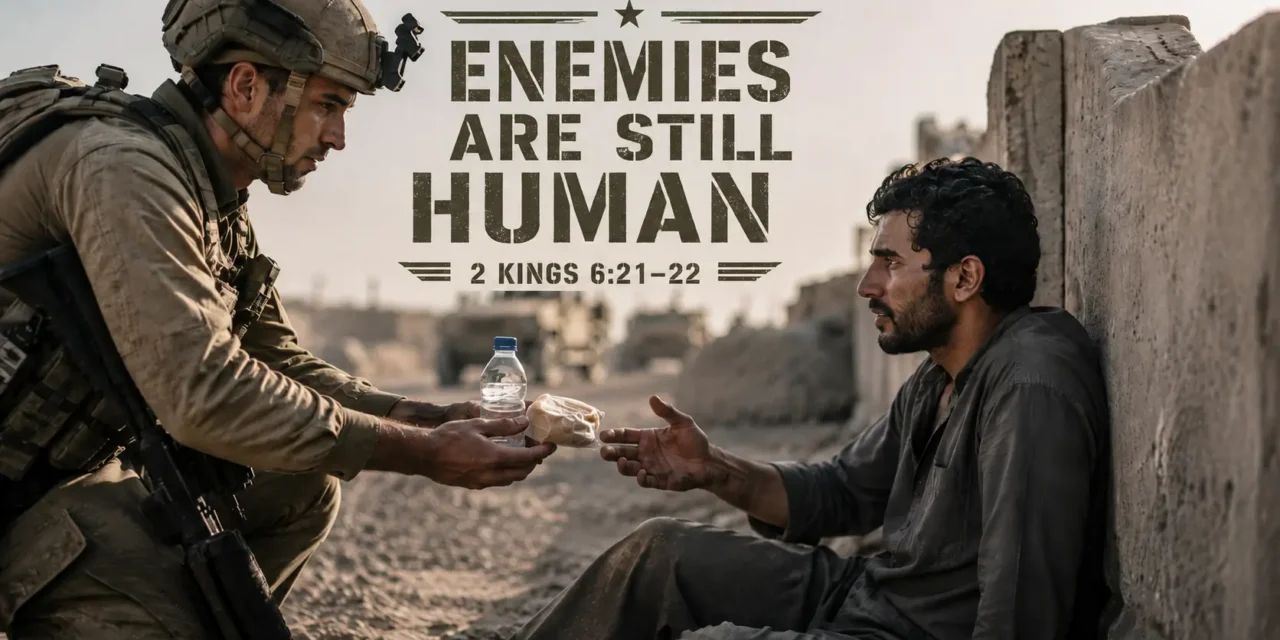
“When the king of Israel saw them, he shouted to Elisha, ‘My father, should I kill them? Should I kill them?’
‘Of course not!’ Elisha replied. ‘Do we kill prisoners of war? Give them food and drink and send them home again to their master.’”
2 Kings 6:21–22 NLT
The king’s question comes surprisingly fast:
The enemy has been captured. The threat is contained. The danger is standing right in front of him. And his first instinct is, “Should I kill them?”
Not once.
Twice.
“Should I kill them? Should I kill them?”
Elisha’s answer is not complicated. He does not give a long lecture. He does not need a committee meeting, a strategy session, or a comment thread with 900 angry replies. He simply says, “Of course not!”
Then he gives a command that feels deeply uncomfortable in a world that often confuses strength with harshness: feed them, give them something to drink, and send them home.
These were not friendly neighbors dropping by for sweet tea. These were enemies. Captured enemies. And still, Elisha says they must be treated humanely.
That matters.
Because once we label a group of people as “the enemy,” it becomes dangerously easy to stop seeing them as people. We reduce them to a category, a threat, a headline, a policy problem, a talking point. But Scripture keeps pulling us back to something deeper: human beings are made in the image of God.
Justice and laws matter, but God’s people should never become comfortable with cruelty toward human beings who still bear the image of God.
That sentence is not a political slogan. It is a biblical warning.
Christians can believe in justice. Christians can care about laws. Christians can discuss borders, safety, citizenship, and national responsibility. These are not small issues, and wisdom matters. But if our hearts grow cold toward suffering people, if we begin to enjoy humiliation, if we cheer when human beings are treated as less than human, something has gone wrong in us.
Jesus did not tell us to love our enemies because enemies are easy to love. He told us because His kingdom is not shaped by the instincts of fallen man. “Love your enemies,” He said. “Pray for those who persecute you” (Matthew 5:44).
And at the cross, Jesus did not merely teach this. He lived it.
While we were sinners, Christ died for us. While we were rebels, He showed mercy. While we were enemies, He reconciled us to God.
So yes, laws matter.
Justice matters.
Truth matters.
But mercy matters too. And for Christians, mercy is not weakness. Mercy is one of the family traits of those who have been rescued by Jesus.
The question is not whether every political issue is simple. They are not.
The question is whether our hearts are still being discipled by Christ.
When we speak about people we fear, disagree with, or consider a threat, do we still sound like followers of Jesus?
Or have we learned to ask too quickly, “Should I kill them? Should I kill them?”
Elisha’s answer still speaks.
Of course not.
Feed them.
Give them drink.
Remember they are human.
Pray This
Lord Jesus, guard my heart from cruelty disguised as conviction. Teach me to love what is just, speak what is true, and still show mercy to people made in Your image. Help me not to be discipled by fear, anger, or political outrage, but by Your cross. Amen.









Recent Comments