
🎙️ Christian Daily News Podcast • Episode 005 • 9-minute listen
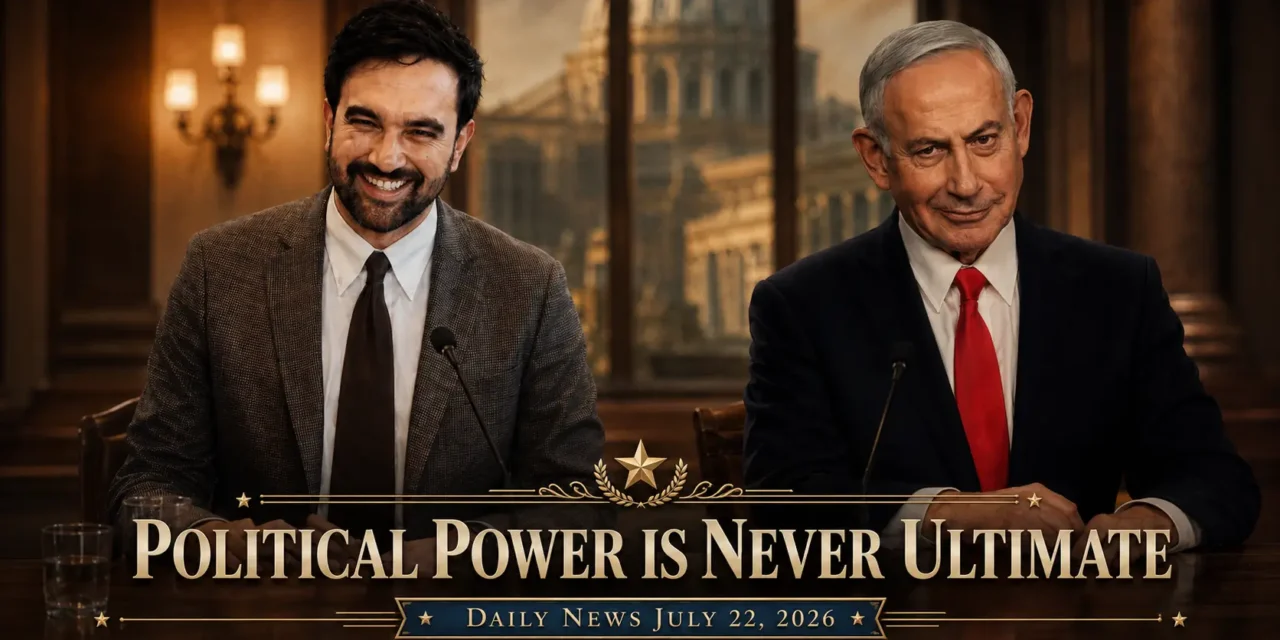
Zohran Mamdani did not change his opinion about Benjamin Netanyahu.
What changed was his acknowledgment of what the office of New York City mayor can actually do.
That distinction matters.
A political leader may possess strong convictions, win an election and receive genuine governmental authority. But taking office does not grant that leader every power necessary to carry out every promise.
Authority is real. But authority has boundaries.
Earlier, Mamdani had discussed the possibility of New York police arresting Netanyahu if the Israeli prime minister entered the city. The proposed arrest would have been based on a warrant issued by the International Criminal Court.
But after his administration reviewed the legal questions, Mamdani acknowledged that New York City does not have the authority to execute that warrant. He continues to support it, and he has shifted his demand to the federal government.
That is the important development.
Mamdani has not withdrawn his criticism of Netanyahu. He has not rejected the International Criminal Court. He has not said that the allegations are false.
What he has conceded is much narrower: the mayor of New York cannot independently order an arrest simply because he believes that arrest should happen.
Winning an election gives a mayor a long list of responsibilities, but it does not unlock the federal-government expansion pack.
And beneath the legal controversy is a question every government official eventually encounters:
Where does my authority end?
The International Criminal Court issued its warrant for Netanyahu on November 21, 2024, concerning allegations of war crimes and crimes against humanity connected to the war in Gaza. Israel rejects those allegations. And we need to be precise here: an arrest warrant is not the same thing as a criminal conviction.
That distinction does not make the allegations unimportant. It means we should describe them truthfully.
The United States is also not a party to the Rome Statute that established the International Criminal Court. An ICC warrant does not automatically become an enforceable American arrest warrant merely because the person named in it enters New York City.
There are complicated questions here involving international law, federal authority, diplomatic immunity and travel connected to the United Nations. This episode cannot resolve all of them, and Scripture does not secretly provide the missing pages of an international-law textbook.
But one conclusion is clear enough: supporting an arrest does not give a mayor the legal authority to carry it out.
And that brings us to an extraordinary conversation in John 19.
Jesus is standing before Pontius Pilate. Pilate is frustrated because Jesus will not answer him as he expects. So Pilate reminds Jesus that he possesses the authority to release Him or have Him crucified.
Pilate speaks as though the power belongs to him completely.
Jesus answers:
“You would have no power over me at all unless it were given to you from above.”
Notice what Jesus does not say.
He does not say Pilate has no authority. Pilate occupies a real governmental office. His decisions will produce real consequences. Before the day is over, he will issue the order that sends Jesus to the cross.
But Jesus tells Pilate that his authority is not self-created.
It has been given.
That means it is delegated, limited and accountable to someone greater.
Pilate can make a ruling, but he does not rule the universe. He can pronounce a sentence, but he does not possess final judgment. He can exercise power over Jesus’ body, but he cannot seize control of the Father’s sovereign purpose.
The same principle applies to every human office.
A mayor has real authority.
A president has real authority.
A judge has real authority.
A police officer has real authority.
But none of them possesses every authority, and none of them is the source of the authority they possess.
Mamdani may sincerely believe that justice requires Netanyahu’s arrest. People may agree or disagree with him about that. But sincerity cannot supply jurisdiction that the law has placed elsewhere.
God’s sovereignty does not mean every legal opinion offered by a ruler is correct. It does not mean every government policy carries divine approval. Pilate’s authority came from above, and Pilate still used that authority unjustly.
Human leaders remain responsible for what they do with the power entrusted to them.
Daniel 2 says that God changes times and seasons, removes kings and establishes kings. Political offices do not exist outside His providence. Leaders may believe they are directing history, but they are never operating beyond God’s sight, knowledge or rule.
That does not make political decisions unimportant.
It puts them in perspective.
Mamdani’s concession is significant because governing requires more than declaring what you believe should happen. Governing also requires understanding which office has authority, which process applies and where legal responsibility belongs.
In that sense, acknowledging the limitation was better than continuing to claim a power the city does not possess.
But leaders should ideally discover those limits before making sweeping public promises.
And this is where I need to turn the question away from City Hall and toward my own understanding of God.
How often does my peace depend on a political leader having enough power to produce the outcome I want?
We can begin treating an election, a court ruling or a government policy as though everything depends upon the person holding that office.
When our preferred leaders win, we breathe easier.
When they lose, we may begin acting as though God has lost jurisdiction.
But no mayor, president, court or international institution is the final authority.
That does not mean we withdraw from public life. It does not mean we stop caring about justice, suffering or responsible government. Christians should care about how authority is exercised because rulers make decisions that affect real people.
It means our confidence rests somewhere higher.
Christ stood before Pilate without confusion about who truly ruled that moment.
Pilate appeared to control the outcome. He could release Jesus or condemn Him. Yet Jesus understood that Pilate’s authority existed within boundaries established by God.
Jesus was not helpless before human power.
He willingly continued toward the cross according to the Father’s plan. Pilate authorized the crucifixion, but Pilate was never the ultimate ruler of Calvary.
At the cross, earthly authority reached what appeared to be its greatest victory. Jesus was condemned, crucified and placed in a tomb.
Then, on the third day, the risen Christ demonstrated the limit of every human sentence.
Governments can issue rulings.
Courts can pronounce judgments.
Officials can exercise the power entrusted to them.
But Jesus Christ possesses authority over life, death and the final judgment of every nation and ruler.
So here is the question I am asking myself:
Does my confidence rest in political leaders having enough power to secure the outcomes I want, or in the sovereign God who stands above every human authority?
Choose one public issue that has been creating anxiety in you.
Name the leaders, courts or institutions involved when you pray. Ask God to give them wisdom and justice. Acknowledge that their authority is real—but limited. Then deliberately affirm that God’s rule does not end where their power ends.
Mamdani may still believe Netanyahu should be arrested, but he now acknowledges that New York City does not possess the authority to do it.
Every human office eventually meets that boundary.
And beyond that boundary stands the God from whom all authority comes.
Pray This
Father, You are sovereign over every nation, government and ruler. Give our leaders wisdom to understand the authority entrusted to them, courage to act justly within its limits and humility to remember that they remain accountable to You. When political decisions make us anxious, teach us to pray faithfully, pursue truth carefully and rest our confidence in Jesus Christ, the King above every earthly power. Amen.








Recent Comments