
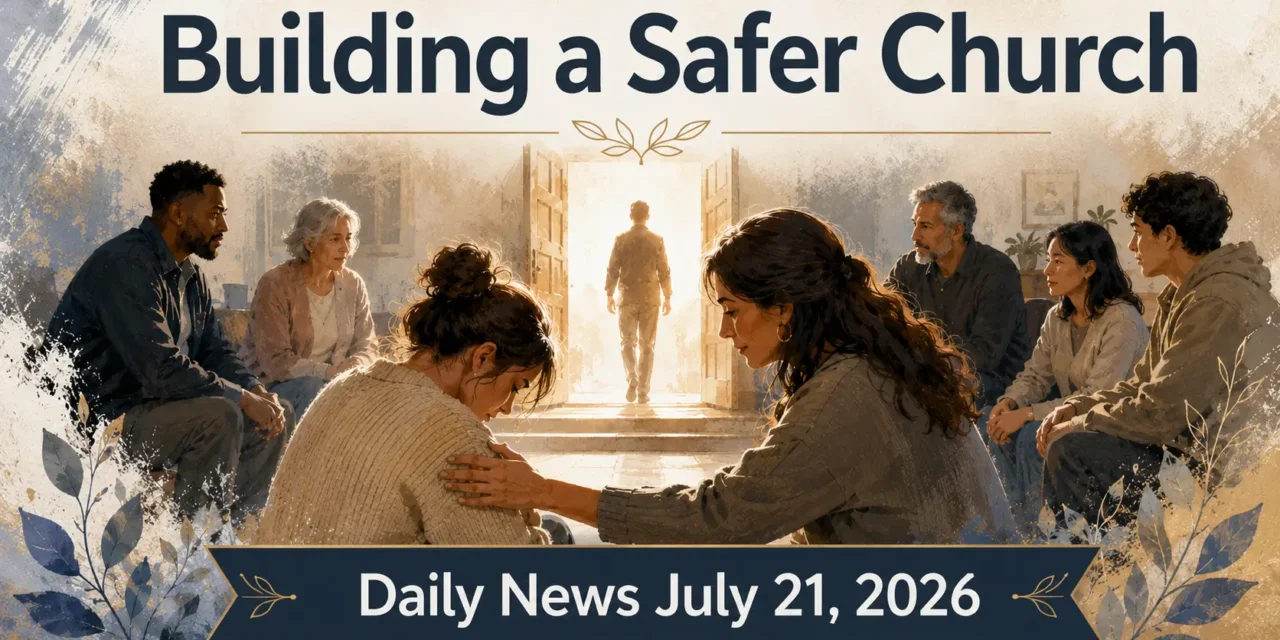
🎙️ Christian Daily News Podcast • Episode 004 • 9-minute listen
A lawsuit may end.
A church’s responsibility does not.
Legal proceedings can be settled, dismissed, delayed, or resolved privately. Documents can be sealed. Terms may never become public. Questions may remain unanswered.
But none of that removes the responsibility of the church to protect vulnerable people.
That responsibility does not belong only to pastors, denominational leaders, attorneys, or governing boards.
It belongs to the members too.
The recent lawsuit involving Southwestern Baptist Theological Seminary, former seminary president Paige Patterson, and a woman identified publicly as Jane Roe ended shortly before trial. The complete terms of the resolution were not publicly disclosed.
There is a lot we do not know, and this episode is not an attempt to determine what happened between the parties.
The deeper issue for the church is this:
- What kind of community are we building when someone says they have been harmed?
- Do we become a place where vulnerable people can speak without immediately being treated as a threat?
- Or do we become so committed to protecting leaders, routines, ministries, and reputations that the hurting person quietly becomes the problem?
This is not only a leadership question.
It is a membership question.
Church culture is not created by the pastor alone. It is created by what the congregation rewards, excuses, questions, ignores, and refuses to tolerate.
Members help determine whether a church becomes a safe place or a silent place.
And silence can become its own kind of protection—not protection for the vulnerable, but protection for the institution.
I have experienced church authority being protected in ways that made the wounded feel secondary.
Again, I am not saying that happened in this particular case. I am speaking about a broader pattern I have personally seen.
When allegations arise, people sometimes become more concerned about what will happen to Sunday services than what may have happened to a person.
- Who will preach?
- Who will oversee the weddings and funerals?
- What will happen to the ministry?
- What will people in the community think?
Those may be understandable concerns, but they cannot become more important than protecting people.
The church was not created to preserve a schedule.
It was created to reflect Christ.
And Christ repeatedly moved toward those who were vulnerable, overlooked, silenced, rejected, and pushed to the edges.
Isaiah 1:17 says,
Learn to do right; seek justice.
Defend the oppressed.
Take up the cause of the fatherless;
plead the case of the widow.”
Those words were originally spoken to a religious community that continued its worship while neglecting justice.
- They had gatherings.
- They had sacrifices.
- They had religious activity.
But God rejected the idea that worship could remain acceptable while vulnerable people were left unprotected.
That warning still matters.
A church can sing loudly, preach accurately, grow rapidly, and remain dangerously unprepared to protect someone who has been harmed.
Good theology on paper does not automatically produce safety in practice.
Protection requires intention.
- It requires policies and accountability.
- It requires leaders who can be questioned.
- It requires members who are willing to ask difficult questions without being accused of disloyalty.
- It requires a congregation that understands that unity does not mean silence.
Sometimes people confuse protecting the vulnerable with attacking the church.
But protecting vulnerable people is part of being the church.
The reputation of Christ’s church is not preserved by hiding weakness. It is preserved when His people respond to weakness with truth, repentance, justice, and compassion.
We should want churches where someone can report harm without being treated as a disruption.
- Where concerns are documented rather than dismissed.
- Where appropriate authorities are contacted rather than avoided.
- Where qualified professionals are involved when needed.
- Where leaders do not investigate themselves.
- Where spiritual language is never used to pressure someone into silence.
- And where forgiveness is not demanded as a substitute for safety, accountability, or justice.
Forgiveness is central to Christianity.
But forgiveness does not mean pretending harm did not happen.
- It does not mean removing consequences.
- It does not mean restoring someone to leadership without wisdom, accountability, and demonstrated repentance.
- And it certainly does not mean asking the vulnerable person to carry the cost of keeping everyone else comfortable.
That is why James 3:1 says that “not many of you should become teachers…because you know that we who teach will be judged more strictly.”
That means spiritual authority must come with greater accountability.
The more influence a leader has, the more carefully the church should build systems that protect people from the misuse of that influence.
Accountability is not an insult to a good leader.
It is a safeguard for the leader, the congregation, and the vulnerable.
And members must be committed to it.
We cannot say, “That is the board’s responsibility,” and then ignore how our own loyalties shape the church’s culture.
For example:
- Do we become defensive whenever someone raises a concern about a respected leader?
- Do we assume that questioning authority is rebellion?
- Do we pressure wounded people to remain quiet because we fear scandal?
- Do we value the appearance of peace more than the hard work required to make peace real?
These questions are uncomfortable because they turn the issue toward us.
- It’s easy to criticize what another church handled poorly.
- It’s even harder to ask whether our own church is prepared.
- Do we know how allegations of abuse or misconduct are reported?
- Is there a clear process?
- Can someone report concerns outside the direct authority of the person being accused?
- Are members taught what to do when a child, adult, volunteer, or staff member says they’ve been harmed?
- Does the church cooperate with legal authorities when the law requires it?
- Are people trained to respond compassionately without making promises they cannot keep?
These are not secondary administrative details.
They are expressions of love for our neighbor.
Jesus did not treat vulnerable people as obstacles to ministry.
Protecting them was part of His ministry.
- He welcomed children when others considered them an interruption.
- He listened to people others wanted to silence.
- He confronted leaders who used spiritual authority to place heavy burdens on others while refusing to help carry them.
- And at the cross, Jesus showed us that love does not protect itself at the expense of others.
Christ gave Himself for the weak.
He did not demand that the weak sacrifice themselves to preserve His comfort, status, or reputation.
That should shape the culture of every church bearing His name.
The gospel does not make us defensive.
- It makes us truthful.
- It gives us the freedom to admit when our systems have failed.
- It gives us the courage to repent.
- It gives us the humility to listen.
- And it gives us the responsibility to move toward those who may be hurting rather than treating them as threats to the ministry.
So here is the central question:
What commitment am I willing to make to help my church protect vulnerable people?
Not merely what do I believe churches should do.
What will I do?
This week, learn the reporting and safeguarding procedures in your own church.
- Ask who receives allegations.
- Ask whether there is an independent process.
- Ask how children and vulnerable adults are protected.
- Ask what training leaders, volunteers, and members receive.
- And when someone speaks about harm, resist the instinct to protect the institution before you have cared for the person.
- Listen.
- Take the concern seriously.
- Follow the proper reporting process.
- Involve the appropriate authorities.
- And refuse to use spiritual language to make the problem disappear.
A court case may end without answering every question.
But the calling of the church remains clear.
Seek justice.
Correct oppression.
Protect the vulnerable.
And make sure our churches are places where the wounded are not sacrificed to preserve the comfort of everyone else.
Pray This
Father, make our churches places of truth, compassion, safety, and justice. Give leaders humility to welcome accountability, and give members courage to speak when vulnerable people need protection. Forgive us when we have valued reputation, routine, or comfort more than the wounded. Teach us to listen carefully, act wisely, report faithfully, and reflect the heart of Christ toward those who are weak or afraid. In Jesus’ name, amen.
This is a transcript of our daily podcast.
Be sure to check out our Series on Church Hurt and how to go through it and be healed.










Recent Comments