
🎙️ Christian Daily News Podcast • Episode 006 • <8-minute listen
Christians can become strangely confident when a celebrity talks about faith.
One public moment, and we’re ready to assign either a halo or a warning label.
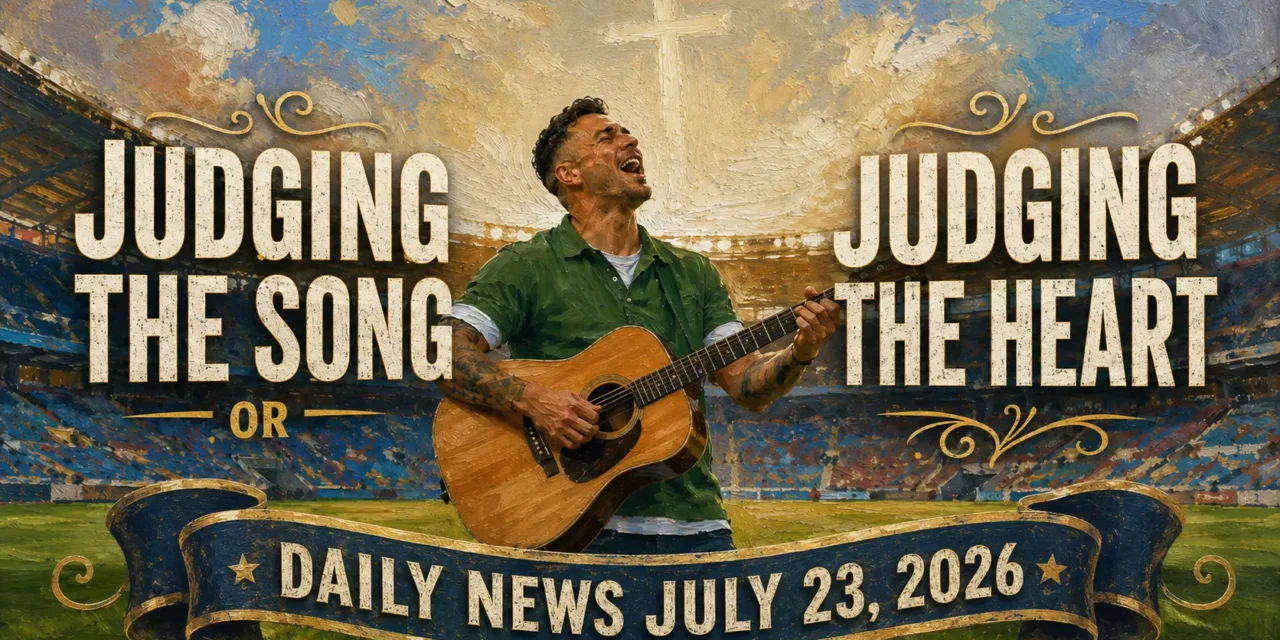
Justin Bieber sings a faith-filled song during the World Cup Final, and almost immediately, people begin explaining what happened inside his heart. Some call it worship. Others dismiss it as performance.
But can we appreciate what was said without pretending we know why he said it?
During the World Cup Final halftime show on July 19, Bieber performed an acoustic version of his song “Everything Hallelujah.” Instead of reaching for one of his biggest older pop hits, he stood with a guitar and sang words that spoke openly about God and faith.
The performance wasn’t completely separate from the event. Bieber changed part of the ending to include World Cup-themed lyrics. So this wasn’t exactly a Sunday morning worship set dropped into the middle of a soccer match.
Still, the choice stood out.
According to recently reported streaming data, global streams of the song more than doubled around the time of the performance. Millions of people who may never have heard the song before were suddenly listening to faith-oriented words because of what happened in that stadium.
That is worth noticing.
It is also worth being careful about.
Some Christian outlets described the moment as Bieber using one of the world’s largest stages to worship God. That interpretation may be correct. I’m not saying it wasn’t worship.
I’m saying we do not have a verified statement from Bieber explaining what he intended the performance to be.
We know what he sang.
We know where he sang it.
We know that the song contains explicitly Christian language.
We do not know everything that was taking place in his heart.
And that distinction matters because Christians often react to celebrity faith in one of two ways.
Some of us become so excited that a famous person mentioned God that we immediately construct an entire testimony around the moment. We fill in the missing chapters, approve the movie rights, and have the celebrity scheduled to speak at next year’s conference before the final note has finished ringing.
Others move just as quickly in the opposite direction.
They assume it must be fake. They point to the person’s past, their public inconsistencies, their music, their reputation, or the commercial setting and decide that sincerity is impossible.
One group says, “This proves everything.”
The other says, “This means nothing.”
Both may be claiming more knowledge than they actually possess.
This is where God’s words to Samuel become important.
In 1 Samuel 16, God sent Samuel to anoint the next king of Israel. When Samuel saw Eliab, one of Jesse’s sons, he was impressed by his appearance. Eliab looked like someone who should be king.
But God told Samuel not to judge by outward appearance or physical stature. People look at what is visible, but the Lord looks at the heart.
That passage is not telling us to ignore everything people publicly say and do. Scripture repeatedly calls us to discern truth, examine fruit, reject false teaching, and live wisely.
But discernment has boundaries.
We can observe an action. We can examine words. We can evaluate whether a message agrees with Scripture.
What we cannot do is climb into another person’s soul and announce that we have discovered the private motive behind it.
God did not tell Samuel that appearances never matter. He reminded Samuel that appearances do not reveal everything.
I had to ask myself why I was so eager to settle the question about Bieber’s performance.
Was I trying to encourage faith?
Or was I trying to write someone else’s testimony for him?
Maybe the better response is simpler.
We can be grateful that words about God were heard in a place where they were unexpected. We can recognize that millions of people encountered a song containing Christian truth. We can hope the performance reflected sincere faith.
And then we can stop before claiming what only God knows.
Paul gives us an interesting example of this kind of restraint in Philippians 1. He describes people preaching Christ with very different motives. Some preached from goodwill. Others preached from selfish ambition and even hoped to make Paul’s imprisonment more painful.
Paul did not call mixed motives good.
But he still rejoiced that Christ was being proclaimed.
That does not mean every religious message should be celebrated simply because someone uses the word “God.” That word can carry very different meanings depending on who is using it. Christians are not merely people who believe vaguely in a higher power. We confess Jesus Christ—the name above every name—as Lord.
So discernment remains necessary.
We should ask what was actually said. Does it reflect biblical truth? Does it point clearly toward the God revealed in Scripture? Is Jesus being proclaimed, or is spirituality being kept safely generic enough to mean almost anything?
Those are fair questions.
But there is a difference between examining a message and issuing a final verdict on the messenger’s heart.
And here is the part celebrity culture can make us forget: Jesus does not become more glorious because someone famous sings about Him.
Christ was Lord before the halftime show began.
He remained Lord when the cameras moved away.
The gospel is not made true by the popularity of the person speaking about it. It does not become stronger because the performer has millions of followers. It does not collapse because that person later disappoints us.
Jesus Christ does not need celebrity validation.
His authority does not rise and fall with streaming numbers, public approval, artistic reputation, or the spiritual consistency of the people who speak His name.
He is Lord when His name is sung in a stadium.
He is Lord when His name is whispered beside a hospital bed.
He is Lord when an unknown believer prays alone in a quiet room and no camera records it.
And maybe that brings us to the question that matters most.
Am I more interested in deciding whether someone else’s worship is sincere than examining whether my own life is surrendered to Christ?
It is easy to analyze a celebrity’s song choice.
It is harder to ask whether my worship continues after the music stops.
Do my words about God match the way I treat people?
Does my faith shape my private decisions?
Is Jesus merely part of the language I use, or is He truly Lord over the life I live?
The next time a celebrity speaks publicly about faith, pause before sharing the headline or posting your verdict.
Separate three things.
What was actually said.
What you are assuming.
And what only God can know.
Celebrate truth when truth is spoken. Exercise discernment about what is being communicated. But leave the human heart in the hands of the One who can actually see it.
We can thank God when His name is heard in the stadium.
We just should not pretend that a seat in the audience gives us a window into someone else’s soul.
Pray This
Father, give us discernment without cynicism and encouragement without exaggeration. Keep us from judging motives You have not revealed. Help us recognize truth when it is spoken, but keep our confidence centered in Jesus rather than in famous people. Examine our own hearts, and teach us to worship You with more than words and music. Let our whole lives belong to Christ. Amen.










Recent Comments